The Future of HVAC: Conventional vs Magnetic Bearing Chillers

In the dynamic world of HVAC technology, a debate is unfolding, and it revolves around the choice between Conventional Chillers and the cutting-edge Magnetic Bearing Chillers. At Colonialwebb, we are your trusted HVAC partner, equipped with the expertise to guide you through this pivotal decision. Below, we delve into the key points you need to consider regarding these two chiller options.


Magnetic Bearing Chillers: Elevating Efficiency and Precision
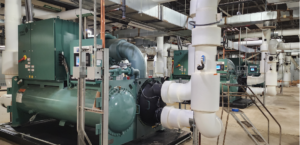
York Magnetic Bearing Chiller

Advantages:
Higher Efficiency: When it comes to energy efficiency, Magnetic Bearing Chillers are a game-changer, particularly at partial load conditions. They usher in lower energy consumption and operational costs, ensuring sustainability for your HVAC systems.

Reduced Maintenance: Embracing state-of-the-art magnetic bearing technology, these chillers bid farewell to cumbersome mechanical bearings. The result? Reduced maintenance requirements and minimal downtime, saving you valuable time and resources.

Unprecedented Reliability: By eliminating mechanical bearings, they offer unrivaled system reliability. Say goodbye to bearing-related failures and hello to uninterrupted performance.

Precise Control: Magnetic bearings empower you with unparalleled control over compressor speed and operation. This precise control translates to superior performance and precise temperature regulation, enhancing the comfort and efficiency of your HVAC system.

Disadvantages:
Premium Initial Cost: Magnetic Bearing Chillers may command a higher upfront investment, attributable to the advanced technology they boast. However, the long-term benefits far outweigh this initial cost.

Specialized Expertise: Maintenance and repair of magnetic bearing systems might necessitate specialized knowledge and equipment. But worry not, as ColonialWebb has the expertise to ensure your system stays in top-notch condition.

Limited Availability: Depending on your location and market, Magnetic Bearing Chillers might have limited availability and service options. Yet, their widespread adoption is on the rise.

Conventional Chillers: A Cost-Efficient Classic

Advantages:
Cost-Effective Entry: Conventional Chillers are known for their budget-friendly initial cost, making them an accessible option for many HVAC projects.

Familiar Technology: These chillers rely on well-established technology, allowing maintenance personnel with general HVAC expertise to efficiently handle repairs and maintenance tasks.

Accessibility: Conventional Chillers enjoy widespread availability and have firmly established their presence in the market.

Disadvantages:

Efficiency Challenges at Partial Loads: In scenarios where full capacity isn’t necessary, Conventional Chillers may exhibit lower efficiency, resulting in higher energy consumption and operational costs.

Maintenance Demands: Mechanical bearings, inherent to conventional chillers, demand regular maintenance, potentially leading to more frequent downtime.

Reliability Concerns: Over time, mechanical bearings can wear out, potentially causing operational disruptions and heightened maintenance needs.
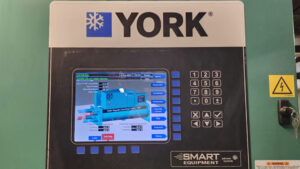
York Magnetic bearing chiller panel

Key Considerations: Making an Informed Choice

When choosing between magnetic bearing and conventional chillers, consider the following factors:

Energy Efficiency Goals: If prioritizing energy efficiency is paramount, especially in situations where varying loads are expected, Magnetic Bearing Chillers could be the ideal choice.

Budget: Assess your initial budget and weigh the potential long-term savings. Remember that Magnetic Bearing Chillers offer substantial efficiency gains over time.

Maintenance Resources: Evaluate the availability of maintenance expertise and the impact of downtime on your operations. Magnetic Bearing Chillers shine in minimizing downtime.

Application: The unique cooling requirements of your application can sway your decision. Magnetic Bearing Chillers excel in applications requiring precise temperature control.

Long-Term Cost Analysis: Undertake a comprehensive lifecycle cost analysis, factoring in upfront costs as well as long-term operational and maintenance expenses.


Your Tailored HVAC Solution Awaits

In conclusion, there is no single answer to the Magnetic Bearing Chillers vs. Conventional Chillers problem. Your choice hinges on your specific circumstances and priorities. The good news is that ColonialWebb stands ready to assist you. We recommend scheduling a consultation with one of our HVAC professionals to receive a personalized recommendation tailored to your unique needs. Elevate your HVAC system to new heights with ColonialWebb, your partner in innovation and efficiency.

Electrical Circuits: Underslab versus Overhead

Colonialwebb’s  Electrical Construction team are experts in installing circuits in various applications depending on the needs of our customer. However, our preferred method of running electrical circuits is to install it under the building slab. We enter the project early, before the concrete is poured and the other trades compete to work in the same space. This offers advantages in terms of labor efforts. Each method has its own advantages and considerations based on the specific requirements of the building and its intended use.

Underslab Electrical Circuits


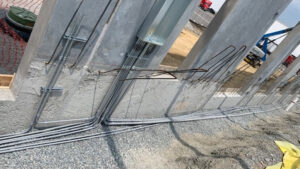
Electrical circuit installed underslab

Installation: Underslab electrical circuits involve placing electrical conduits and wiring underneath the cement slab or foundation of a building during its construction or renovation.

Advantages:

Aesthetics: Underslab wiring is pleasing to the eye as there are no visible wires or conduits on the walls or ceilings.
Space Saving: It saves wall and ceiling space, allowing for a cleaner and more open appearance.
Durability: Wiring under the slab is protected from potential damage caused by environmental factors or accidental impact.

Considerations:

Installation Complexity: Installing underslab wiring requires coordination with other construction activities and careful planning to ensure that conduits are properly placed.
Accessibility: In case of future changes or repairs, underslab wiring might require breaking up the cement floor. As a result, disruption and costs can add up.
Limited Flexibility: Changes to the electrical layout might be challenging after the concrete slab is poured.


Overhead Electrical Circuits


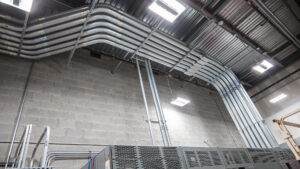
Electrical circuit installed overhead

Installation: Overhead electrical circuits involve mounting conduits, wiring, and fixtures on walls, ceilings, or exposed support structures of the building.

Advantages:

Accessibility: Overhead wiring is easier to maintain, repair, and modify, as it doesn’t require breaking cement.
Flexibility: Changes to the electrical system are relatively easier to perform as conduits and wiring are easy to reach.

Considerations:

Aesthetics: Overhead wiring might be less visually appealing as conduits and wires are visible.
Space Usage: Overhead wiring can take up wall and ceiling space, affecting interior design and aesthetics.
Vulnerability: Overhead wiring can be susceptible to damage from impacts or environmental factors.

Conclusion:

The choice between underslab and overhead electrical circuits depends on factors such as the design, purpose, looks, future flexibility, and budget. A combination of both methods are common. Circuits placed above for easier access and others placed underslab for a cleaner appearance and protection. Let ColonialWebbs Electrical experts help, Schedule a consult with one of our professionals to help you consider the specific needs of the project before making a decision.

Clean Air Using Bipolar Ionization and Ultraviolet Irradiation

Breathing clean air is essential for living and maintaining a healthy life. Indoor air quality is easy to forget about, although many of us spend the majority of our time inside. Whether it’s an office building or a healthcare facility, air quality is important. The conversation around indoor air purification has intensified in recent years due to COVID-19. Two effective ways of cleaning indoor air are bipolar ionization and ultraviolet irradiation in your HVAC systems.

Bipolar Ionization

Bipolar Ionization, or BPI, converts oxygen molecules to charged ions using electric voltage. These charged ions are effective against viruses, bacteria, and mold. The ions attach to contaminants and make them large enough for HVAC system filters to capture them. Some contaminants become heavy enough to fall onto surfaces that are easier to clean.
ions created for bipolar ionization to clean air

BPI also removes organic compounds, odors, and allergy-causing dangers. Bipolar Ionization doesn’t replace MERV air filtration but helps boost the filtration system.

Ultraviolet Irradiation

Ultraviolet light is one of several types of light that exist within the entire light spectrum. UV lamps have long been used to control infectious microorganisms in medical facilities. A UV-C fluorescent lamp generates light that can inactivate mold, bacteria, and viruses.
Light spectrum ranging from infrared to ultraviolet

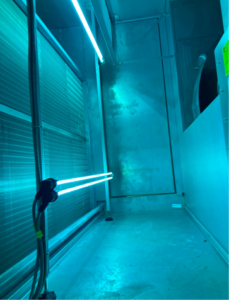
Ultraviolet HVAC systems come in two main categories: air sterilization and coil sterilization. Air Sterilization is an in-duct system. It disinfects the air as it moves through the ducts of an HVAC system.  Coil Sterilization is a more targeted approach to zapping air pollutants. UV HVAC devices are placed near high-risk components such as condensation pans to keep them clean.

Clean Indoor Air Using HVAC Systems

Both bipolar ionization and ultraviolet irradiation are effective ways to ensure the air you’re breathing is clean and healthy. Keeping indoor air free of contaminants starts with your HVAC system. If you’re considering one of these options for an upcoming project or can’t decide between the two, contact the experts at ColonialWebb. The trusted experts at ColonialWebb will advise you on the best system for your big project!

Biofilm in HVAC Systems

Indoor air quality is critical for maintaining a healthy and safe environment for building occupants. Unfortunately, pollutants, allergens, and microorganisms such as bacteria, viruses, and mold can contaminate indoor air, leading to various health issues. Ultraviolet Germicidal Irradiation (UVGI) is a technology that uses ultraviolet (UV) light to inactivate and destroy microorganisms, preventing them from becoming biological hazards.


Biofilm in HVAC Systems

Biofilm is a complex microbial matrix of mold and bacteria that grows on the fins of the HVAC system’s evaporator coils, drain pans, and ducts. What appears as dirt, slime, or sludge on the surfaces of these components is, in fact, biofilm. Biofilm can also grow on other surfaces where moisture and nutrients are present. The presence of biofilm in HVAC systems can create serious health hazards for building occupants.

Numerous studies have demonstrated that improper maintenance of HVAC systems can contribute to the growth and dissemination of pathogenic, opportunistic bacteria, viruses, and mold. Biofilms give off products of metabolism known as volatile organic compounds (VOCs), which can trigger occupant complaints of watery eyes, headaches, and even severe allergy and asthma responses. In some extreme cases, biofilms can lead to Sick Building Syndrome (SBS), a condition in which occupants experience symptoms related to a particular building.

The quality of indoor air is influenced by the levels of bioaerosols, contaminants, and pollutants, which can significantly impact occupant health and development. Therefore, it is essential to take steps to prevent biofilm growth in HVAC systems and improve indoor air quality.


UVGI Technology to Prevent Biofilm Growth

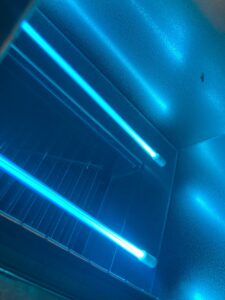
Ultraviolet Germicidal Irradiation (UVGI) technology has proven to be a highly effective means of preventing the growth of biofilms in HVAC systems. UVGI uses ultraviolet energy to inactivate and destroy microorganisms, including bacteria and viruses, by altering their DNA and preventing reproduction. UVGI’s germicidal effect is strongest when using UVC energy, which has a 200 to 280 nanometers wavelength.

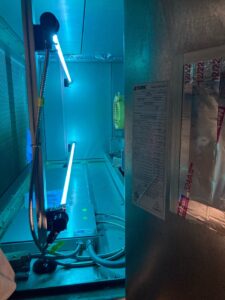
UVGI technology can be applied to HVAC systems in several ways, including using ultraviolet germicidal lamps. These lamps emit a concentrated radiation of ultraviolet energy that destroys microorganisms on contact. Installing UVGI lamps in an HVAC system requires air handlers and duct system modifications to accommodate the lamps. The process also requires new power to feed each lamp.


ColonialWebb and Chesterfield Country School Systems

ColonialWebb’s Special Projects MEP team partnered with Chesterfield County School Systems to install UVGI systems in 15 schools. The installation process involved modifying the HVAC air handlers and duct systems to accommodate the UV lamps. The skilled team of HVAC technicians, sheet metal workers, and electricians performed the installation to include new power to feed each of the lamps.

The partnership between ColonialWebb and Chesterfield County School Systems is an excellent example of how UVGI technology can improve indoor air quality and reduce the risk of illness. ColonialWebb is proud to have worked with the county to provide good indoor air quality to the occupants of the school system.


Benefits of UVGI Technology

UVGI technology is a powerful tool for preventing the growth of harmful biofilms in HVAC systems and improving indoor air quality. By using UVC energy to alter the structure and molecular bonds of microorganisms, UVGI effectively neutralizes their ability to reproduce and become a biological hazard. The partnership between ColonialWebb’s Special Projects MEP team and Chesterfield County School Systems is a prime example of the practical applications of UVGI technology in safeguarding public health. With the potential risks associated with indoor air pollution, it is essential to take action to mitigate these issues.

Consider partnering with ColonialWebb to address your air quality concerns using UVGI technology. Contact ColonialWebb’s team of experts today to learn more about how we can help you improve indoor air quality and safeguard the health of your building occupants.

Preparing Your Facility for Electric Vehicle Charging

Electric vehicles (EVs) have recently been at the forefront of the news. With the rise in popularity of brands like Tesla and Rivian, and a commitment from many auto manufacturers to change from traditional vehicle platforms to EVs, your facility will likely need to accommodate these new vehicles soon. While a move to EVs may reduce our dependency on fossil fuels, electrical infrastructure improvements may become necessary. So, is your facility ready for the coming EV wave?

Facility Considerations

 A few questions a facility manager may want to consider to prepare their facility for onsite charging are:

  • Can our current electrical distribution system support my future EV charging needs?
  • Do we want to offer EV charging for free or at a cost to those who park at our facility?
  • Will EVs be implemented as a fleet solution or only for employee parking/charging?
  • Can onsite EV charging offset some of the costs of a traditional vehicle fleet program?

While many buildings have robust electrical distribution systems, some may operate at or near peak capacity. Therefore, it may be advisable to have a comprehensive load study performed prior to planning for new installations. Adding additional electrical capacity may be an option to give your site the needed bandwidth to install multiple chargers. Alternatively, installing [simple_tooltip content=’Solar energy begins with the sun. Solar panels (also known as “PV panels”) are used to convert light from the sun, which is composed of particles of energy called “photons,” into electricity that can be used to power electrical loads.’]solar PV panels[/simple_tooltip] or upgrading older lighting systems may be a way to offset the energy needs of a new EV charging system. Sub-metering of charging stations can also be a solution to help determine electricity costs.

If your facility is in a high-traffic area or offers public parking, installing EV chargers may be a means of opening your doors to new customers. EV charging can be provided as a free service or generate revenue for your facility, with many charging stations offering payment processing options for users.

Fleet EVs have come into focus as the future of commercial vehicles recently. With operation costs much lower, fleet EVs can offer an appealing option.

When planning for a fleet EV charging system, charging durations, eventual fleet size, and charging frequency should all be considerations.

Where to Start? 

If EVs are in your company’s future, now may be the time to start planning for charging installations. A facility electrical load assessment and equipment survey can help determine if service upgrades are required. Additionally, state and federal tax incentives may be available to help offset the cost of new chargers and electrical wiring. With an entire team of solutions engineers, account managers, and electricians, ColonialWebb can help you determine costs, benefits, and return on investment for upgrading your facility to accommodate electric vehicles.

Facility EV Charging Station

Creating Competitive Advantage Through BIM

In our current age of commercial construction, I can think of no single technological application that rivals Building Information Modeling (BIM) when it comes to meeting the demands of pre- construction planning and execution. BIM provides us the ability to visualize and see our work in the virtual environment, long before the first physical material is procured in the real world. Providing a scalable platform to solve our most complex problems of spatial constraints and system performance, we can utilize geometry and metadata to drive project decision making. At ColonialWebb, we couple this pre-planning ability with leveraging model data to generate material orders, and track our fabrication and installation progress. We use the model as an asset and an information pipeline to communicate to our teams how our build stacks up against our estimates and planning goals. These capabilities of the BIM model help to minimize the risk we expose ourselves to in the volatile industry of mechanical contracting.

Spatial Coordination and System Performance

One of the first ways our company began to see the benefits of BIM was in the practice of spatial coordination. We model all of our projects to 3D Level 400, enabling us to evaluate how our systems will fit within the design structure. All of our sheet metal, piping, and plumbing systems geometrically match exactly what we will build and install, including the hangers and stands needed to support our systems. Inserting our model and comparing our scope of work with other trade contractors
provides us with the ability to identify heavy congested areas, where our work may conflict with other trades. This eliminates a large amount of re-work in our field operations, because we are able to troubleshoot these areas and come up with solutions as a team that serves the customer with a well thought out product in their building.


Planning and Scheduling

Once the model has reached a level of substantial coordination, where everything is in 3D and “fits” as it will be built, we take the next step to pre-construction by modularizing out what will be pre-fabricated on the project. We use the
BIM model to break down fabrication assemblies and schedule them for our manufacturing division. All of our “assemblies” are bulked together across all our projects and tagged with data fields inside the BIM model, so our team can schedule all the pre-fabrication across our company on one common platform. This ability to be transparent enables us to flatten our labor curve and minimize the amount of overtime hours and fatigue to our employees. I am pretty confident in saying that this would be a time consuming and difficult task to accomplish without the BIM metadata helping us understand metrics like: Pounds of sheet metal, Quantities of welded pipe, Linear footage and Diameter Inches of planned pre-fabrication,

ColonialWebb: Creating Competitive Advantage Through BIM
and other such volumetric information that is critical to keep our manufacturing team on time and successful.
Material Procurement
At ColonialWebb our goal is to model as we will install. Another advantage of taking our BIM efforts to the next level is that we are able to link data dashboards directly to our model to generate material lists for quoting and purchasing materials on our projects. We are easily able to filter down material lists by categories such as Floor/Trade/Material so our purchasing agents can release these orders to our shop and field teams in a manner that coincides with performing their installs.
Having the BIM model coordinated helps our company minimize the amount of material overage and directly leads to savings both by buying exactly what we need to build the system, as well as optimizing our systems during the initial stages of modeling. We can cut our material cost down, which translates to labor savings and a more efficient project for the customer.
Fabrication and Installation Tracking
The latest generation of Building Information Modeling technology we are incorporating at ColonialWebb are cloud based model tools to help our project teams track the progress of jobs by communicating through a data driven cloud based selection interface. This tool was developed by our corporate owners, and allows our teams to select model elements
and tag them with data fields once the work is complete for the referenced elements. The interface can be accessed by teammates even without CAD software, and brings us closer to a new dawn of project tracking. We track the reported model information closer to real time, which allows us to provide and verify forecasts of project completion in a digital manner.
The construction technology sector is an extremely exciting space to be in at ColonialWebb. We are envisioning and creating applications for our business through the BIM model at warp speed. Our ColonialWebb leaders provide our family with the freedom and innovative environment to create real competitive advantages in our industry. We pride ourselves on utilizing the BIM model as a project asset for coordination, planning, purchasing, and tracking/forecasting. We are looking toward the future, while staying grounded in our present capabilities, staring through the lens of our virtual model, and aiming our sights on making the built world a better place for our communities.
Brad Mohler Virtual Construction Manager

When BIM Alone Isn’t Enough

When [simple_tooltip content=’Building Information Modeling, or BIM, is a digital representation of physical and functional characteristics of a facility. BIM software is used by to plan, design, construct, operate and maintain buildings and diverse physical infrastructures, such as water, refuse, electricity, gas, communication, utilities, roads, railways, bridges, ports and tunnels.’]BIM (Building Information Modeling)[/simple_tooltip] was initially introduced, it took construction to new heights by allowing industry workers to see the assembly of a building from all angles. To this day, BIM allows trades to better coordinate before arriving at fabrication and means less rework, less material waste, quicker installations and the ability to pre-visualize issues in the field. However, even with the ability to find and resolve issues ahead of time, there are circumstances when BIM doesn’t function the way that it should.

When BIM doesn’t do its job, it might help to ask the following questions:

  1. Was the design well thought out?
  2. Did the design consider the constructability of the building?
  3. Has the maintenance of the building been considered?

The lack of addressing these issues may potentially cause contractors to encounter unforeseen issues during coordination; this includes everything from maintenance clearances, equipment access, valve access, light and grill installation, hangers, and cable tray access. When we don’t account for the constructability and maintenance of a building, it simply causes more rework in the field. This is why it is crucial to allot enough time to coordinate the building properly and ensure that all parties are on the same page for the BIM job. This involves everyone from the architect and engineer, the general contractor, subcontractors, fabrication teams, field teams, and operations teams.

Another consideration in the BIM process is to ensure that the information you have is precise. When renovating, we typically lack accurate field information because digital models consist of straight lines and perfect conditions. Often, the existing building’s structure have long settled and nothing is perfect. On the upside, new technologies are allowing us to scan structures for more accurate depiction of existing buildings.

Again, even with technological advancements, you must have all parties on board for the coordination to be successful. What I mean by this is that BIM alone isn’t enough. Beyond the building model, BIM is a holistic process which involves consideration of the entire project lifecycle, from evaluation to operations and maintenance. The various teams from the design to installation to the maintenance of the building must be on the same page for a virtual building to efficiently come to life.

Renovating Maymont – Behind the Yellow Tape

In this final episode of Behind the Yellow Tape season 2, we chat with Ernie Combs while at Maymont in 2019 when ColonialWebb performed the renovation and expansion on the Westover House. This Mediterranean-style house, located at 1000 Westover Road, was originally built in 1918, and the team was excited to be part of the historic renovation!

What is Virtual Construction? – Behind The Yellow Tape

Have you ever wondered how virtual and augmented reality are used in the construction industry? Check out this video to see how we work with cutting edge technology like the HoloLens to provide accurate and efficient solutions for our customers. Tim is back in our season premiere to show you the cool tools at ColonialWebb!