
Cool Clash: Ammonia vs. Chlorofluorocarbon Refrigerants – Exploring Ammonia Advantages

Refrigeration plays a crucial role in preserving our food and supporting our economy. Without proper refrigeration, our food supply would be at risk, leading to food spoilage, waste, and economic losses. When it comes to industrial applications, two commonly used refrigerants are [simple_tooltip content=’Ammonia is a very-efficient refrigerant and one of the most cost-effective refrigerants for commercial use. Businesses use ammonia refrigerant systems because they can save a lot of money on energy. Also, detecting leaks in an industrial setting is easy because it has a distinct odor. Ammonia is a good choice for eco-friendly businesses because it does not damage the ozone.’]ammonia[/simple_tooltip] and [simple_tooltip content=’

Chlorofluorocarbons (CFCs) are generally a mixture of chemicals commonly used as refrigerants. They are used as propellants in aerosol sprays too. CFCs generally contain different substances, including fluorine, carbon, chlorine, and hydrogen.

Chlorofluorocarbons (CFCs) are colorless and odorless, making them more challenging to detect. CFCs are generally quite volatile and start evaporating immediately when exposed to open air.

That is one of the main reasons why they can be inhaled so easily. Even though CFCs are considered non-toxic, exposure (commonly through inhalation) can result in respiratory issues and may even cause a person to lose consciousness.

‘]Chlorofluorocarbon (CFC)[/simple_tooltip]. In this blog post, we will explore the advantages of ammonia compared to CFC refrigerants and why it is gaining popularity in the industry.

Environmentally Friendly:

One of the most significant advantages of ammonia is its environmentally friendly nature. Ammonia serves as a natural refrigerant that does not deplete the ozone layer. In contrast, CFC refrigerants like R507 and R404 are known to have detrimental effects on the ozone layer and contribute to global warming. By opting for ammonia in refrigeration systems, industries can align themselves with sustainable and environmentally friendly practices, reducing their carbon footprint and helping to protect the environment for future generations.

Longevity:

Ammonia-based refrigeration systems boast a longer lifespan compared to CFC-based systems. This longevity contributes to cost savings and minimizes the need for frequent replacements or repairs. Industries can benefit from reduced downtime and maintenance costs, increasing operational efficiency and productivity.
 

Lower Costs and Electricity Usage:

Ammonia refrigeration systems offer significant cost advantages. The cost of ammonia itself is notably lower than that of CFC refrigerants. Its wide availability and ease of production contribute to these cost savings. Additionally, ammonia-based systems require less electricity to operate due to their higher coefficient of performance (COP). The higher COP ensures that less electricity is necessary to achieve the desired level of cooling, resulting in reduced energy consumption and lower utility bills. By choosing ammonia, industries can enjoy both financial savings and reduced environmental impact.
 

Administrative Requirements:

While ammonia provides numerous benefits, it’s important to note that its usage does come with administrative requirements. Ammonia refrigeration systems are subject to specific regulatory requirements known as [simple_tooltip content=’Process Safety Management, or PSM, is an OSHA regulation that is concerned with processes at your facility that use highly hazardous chemicals.  PSM provides a compliance framework to evaluate each process with the end goal of no spills, fires, explosions, reactions, releases, or other incidents arising from their use. The development, implementation, and ongoing maintenance of a PSM program is not only required for governmental compliance but is critical for employee safety, protection of the environment, and reducing costly downtime.’]Process Safety Management (PSM)[/simple_tooltip] and [simple_tooltip content=’A Risk Management Program (RMP) identifies potential risks which could result in the emission of refrigerant into the atmosphere and outline measures to minimize the possibility of those risks occurring.’]Risk Management Program[/simple_tooltip] (RMP). These regulations aim to ensure the safe handling, storage, and management of ammonia to prevent accidents and safeguard workers, the public, and the environment. Adhering to these administrative requirements is crucial to maintain a safe working environment and mitigating potential risks associated with ammonia usage.

In conclusion, ammonia-based refrigeration systems offer significant advantages over CFC refrigerants. These advantages include energy efficiency, environmental sustainability, longevity, lower costs, and reduced electricity usage. It is worth mentioning that ammonia systems have administrative requirements to ensure safety and regulatory compliance. As the world strives for sustainability and environmentally friendly solutions, ammonia-based refrigeration systems present an excellent choice for industries seeking to reduce their environmental impact, save on energy costs, and promote efficient cooling solutions. We can contribute to a healthier planet and a more sustainable future by embracing ammonia.

For more information, check out our Industrial Refrigeration page or contact us with any questions.

Attaching Elements to Pipe Exterior – Is that Legal?

Within the [simple_tooltip content=’A refrigeration system that utilizes ammonia as the refrigerant. The ammonia absorbs heat from the cold areas and relocates it for heating or rejection to the atmosphere.’]Ammonia Refrigeration[/simple_tooltip] industry, personnel occasionally encounter configurations that could be referred to as “interesting,” for the lack of a better term. Many contractors have regular practices that are certainly surprising. Sometimes, these practices are justified and sometimes, well… not so much.

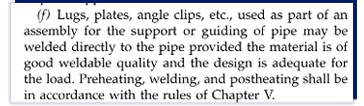
Recently, I was asked the following question: Is it proper to attach clips, brackets, or other elements to the exterior of refrigeration piping? Naturally, one might wonder if such a thing is allowed under ASME B31.5 (the refrigeration piping code). At first, it almost seems counterintuitive to think that B31.5 would permit welding support elements to the exterior of a pipe. However, this practice is actually explicitly permitted as can be seen in the code excerpt below:

From ASME B31.5, 2006 521.3.1 (f)

Additionally, it’s worth pointing out that the 2016 version of ASME has the same exact language. The note that welding must meet the requirements of Chapter V is a nominal one. Again, there is nothing prohibitive in this language regarding the attachment of elements to piping.

Now, Section 531, which addresses heat treatment, is a little more interesting. Within this section, there appear to be two criteria for requiring preheating and postheating of welds. The first one refers to the welding procedure that is used. It states that if the procedure requires heat treatment, then heat treatment is, unsurprisingly, required. The other criterion is table 531.2.1, which indicates that, as a rule, ammonia refrigeration systems will fall under a category where no preheat and postheat treatment is needed. Thus, welding to the piping exterior wouldn’t be a concern under this provision.

So, to answer the initial question, this practice is deemed acceptable according to the “letter of the law.” However, this doesn’t necessarily mean that it should be done. The wise words of Mr. Jeff Goldblum in Jurassic Park come to mind:

From my point-of-view, welding to pipe for the connection of pipe supports is not an excellent practice. If it must be done, I would want to confirm through stress analysis that there is no risk of damaging the pipe due to expansion or other dynamic conditions. Furthermore, if a fabrication aid (like a lifting lug) has been used, insulation issues could occur if the aid is not removed. In such cases, the attachment should be removed and ground smooth before pressure testing to ensure that the piping was not compromised during the removal. And so, it is indeed acceptable to weld components to the exterior of refrigerant piping but remember to proceed with caution!

For more information on ColonialWebb’s Industrial Refrigeration services, click here.